top of page
Search

Growls Tell Stories, Not Status


ree

When Bramble finally arrived, he carried his whole history in his bones. A young, sensitive dog fresh from a noisy out-of-state shelter, he crept through the house with wide eyes and a body wound tight, as if everything might vanish if he blinked. Nothing in his life had ever been certain. Food was often scarce, comfort fleeting, and people unreliable, sometimes even frightening. And now, suddenly, he’d been dropped into Juniper’s world, a world she had known, trusted, and made her own for years.

Juniper was the quiet, steady one. She knew where the sun warmed the carpet just right, which corner of the yard always smelled like rabbits, and exactly how to curl herself into her person’s side on the couch. To her, life was predictable and safe. To Bramble, it was still a storm.

The first growl came over a toy. Bramble discovered a squeaky lamb under the coffee table and curled himself around it like buried treasure. When Juniper wandered over to investigate, Bramble stiffened and let out a low growl. The humans froze. “Oh! I think he’s trying to be alpha. I’ve seen this on TV!” someone whispered.

But - he wasn’t.

That sound wasn’t ambition. It was fear. Bramble was saying, please don’t take this; I don’t know if I’ll ever get another chance to have something of my own.

Later it was Juniper’s person he guarded. Bramble pressed himself tight against their side, soaking up every ounce of touch, his body humming with tension. When Juniper approached for her usual cuddle, the growl came again, louder this time, punctuated with a snap. To the family, it looked like a power challenge. To Bramble, it was desperation: I’ve found safety in this lap, and I can’t bear to lose it.

And one night it wasn’t even about a toy or a person, it was the dog bed. The first soft, warm bed he’d ever had. He flopped into it like a weary traveler who had finally found rest. When Juniper trotted over to join him, his body stiffened once more. The growl was quieter, but no less clear: please, not this too. I need this comfort to myself.

Luckily for Bramble, Juniper spoke the language of dogs. Well-socialized and steady, she could read his signals and understood what he was trying to say, even when the humans didn’t. Not every dog has that skill though, and in many homes those same moments spark real conflict.

Every one of those growls could have been mistaken for a power struggle, a dog climbing some imaginary ladder of rank. That’s the lure of the alpha story, it offers an oversimplified, tidy explanation for much more complicated emotions. Bramble wasn’t fighting for control of the household. He was fighting for safety, one small piece at a time.

I’ll never forget a client who once told me their two-pound, ten-week-old puppy was “trying to boss them around,” “run the house,” and “be alpha.” Imagine that: a tiny infant dog, barely bigger than a guinea pig, supposedly plotting to overthrow the household order. What was really happening? A baby dog, full of normal puppy needs, chewing, crying, exploring, seeking comfort, behaving exactly like a creature who had just left his mother and littermates. But the alpha myth had absolutely convinced this family that every whine, every nip, every attempt to crawl into a lap was a power play.

It wasn’t. It was vulnerability. It was completely normal canine development. It was a baby dog trying to figure out how the big human world worked.

That’s the danger of the alpha story: it makes us see rebellion where there is only need. It makes us believe our dogs are scheming when they’re really just surviving.

And it isn’t only other dogs that become the target of growls and guarding. Sometimes dogs guard from the very people they love. A growl over a food bowl, a stiff body when a hand reaches toward a bone, a snap when someone sits too close on the bed, these moments can feel personal, even threatening. It’s easy to think, “He’s trying to run me” or “She thinks she owns me.”

But again, dogs aren’t plotting household takeovers. They’re communicating the same message Bramble gave Juniper: I’m not okay right now. This feels too important, too vulnerable, too unsafe to lose. Guarding from people doesn’t reveal a hunger for control. It often reveals unmet needs like safety, predictability, or simply the chance to keep something that matters to them.

When we drop the alpha story, we see the truth: a growl at a person isn’t rebellion. It’s communication. Our job isn’t to punish or “put the dog in their place,” but to understand why they felt the need to guard and to help them feel secure enough that they don’t have to.

I live with dogs who remind me daily how easily these behaviors are misunderstood.

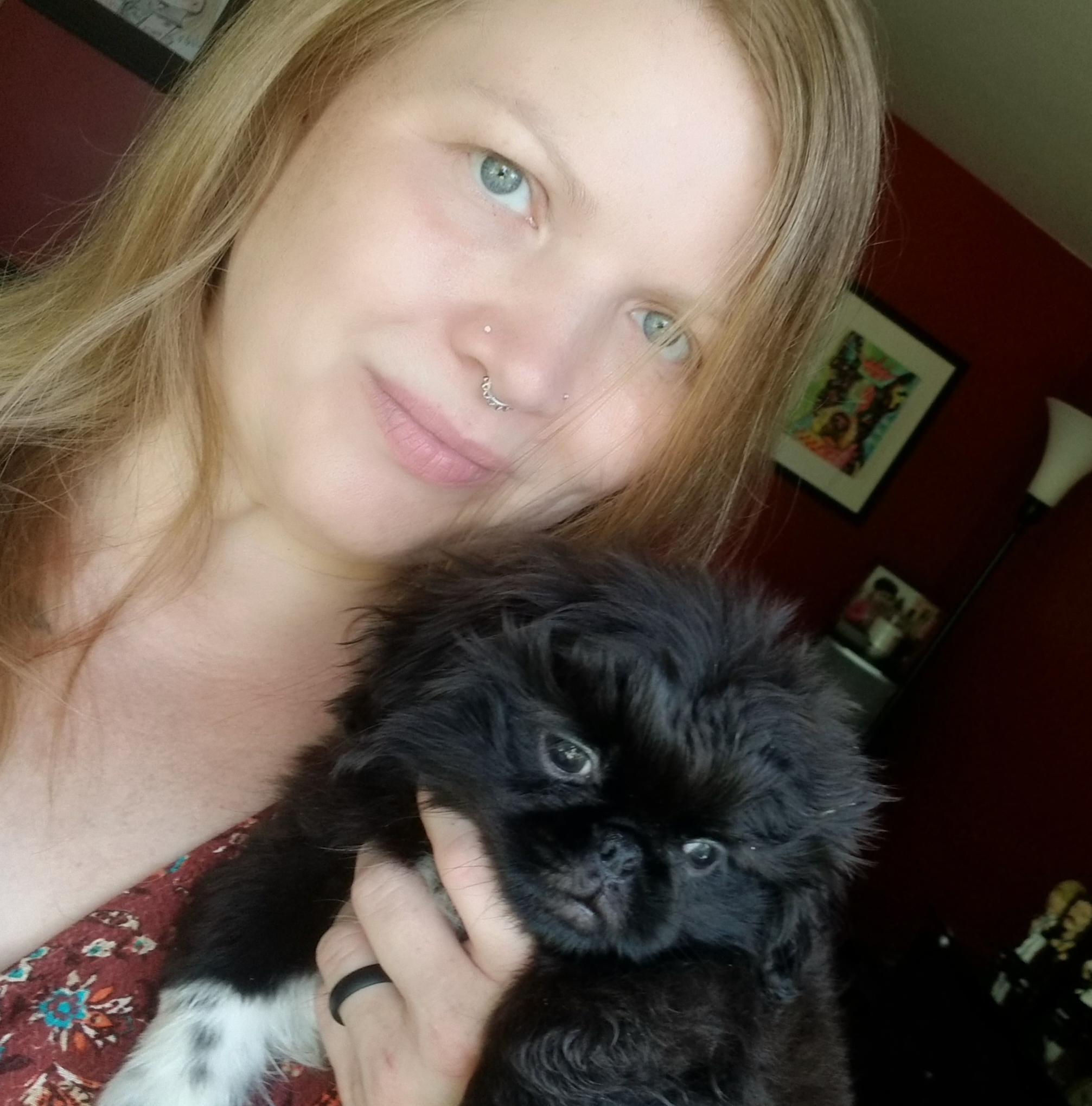
Take Tiangou, my amazing black Pekingese. Most of the time, he doesn’t guard at all. He’s perfectly happy to nap near the others, to let them take the sunny spots, to curl up beside me without protest. But after dinner, when he picks out a bone or chew, it’s different. He plants himself, and with a voice much bigger than his body, he makes his feelings known. He doesn’t guard because he thinks he’s alpha or “the boss.” He guards because, in that moment, the chew feels like the one thing that matters most. It’s his nightly ritual of winding down. His growl says: this is mine right now, I need this.

And then there’s Ghost, my Mudi. Ghost doesn’t really guard, but he’s a controller. If another dog has a ball, suddenly that’s the only ball worth having. If someone’s chewing happily, Ghost hovers, schemes, and always finds a way to get it. To the casual observer, it looks like he is trying to be alpha, he gets what he wants, after all. But Ghost isn’t seeking rank. He’s a tightly wound, herding dog, and control is actually his comfort. The ball isn’t about power over the other dog; it’s about arranging the world on terms that make sense to and comfort him.

These are the kinds of behaviors that always seem to get stamped with the “alpha” label. The newcomer who guards from the resident dog. The little one who growls over a chew. The pushy one who always wants what others have. All of them, misinterpreted as struggles for alpha status, and none of them actually about power.

Dogs don’t guard or control because they’re plotting a coup. They do it because of emotions. Whether it’s fear, insecurity, desire, or stress, a growl is not a manifesto. It’s a message: I’m not okay right now. I need space. I need safety. I need reassurance.

The tragedy of the alpha myth is that it convinces families to almost always answer that message with force. They take away the toy to “show who’s boss.” They scold the growl. They pin the dog, jerk the leash, or let the animals “fight it out.” And in doing so, they prove the dog’s fear right: safety is scarce, comfort can vanish in a heartbeat. The growl goes quiet not because the problem is solved, but because the dog has learned it’s unsafe to speak. And that silence is fragile; it shatters in the form of bites that seem to come out of nowhere. Yet they were never out of nowhere.

The “alpha” idea didn’t even come from dogs at all. It began in the 1940s, when researchers studied groups of unrelated wolves forced to live together in captivity. Those wolves fought and postured in enclosures much too small, and scientists assumed they were constantly battling for rank. The term “alpha wolf” was born. Later research on wolves living in the wild revealed a vastly different truth: packs are simply families, led not by fighters but by parents who raise their young. Even the original researcher, Dr. David Mech, later admitted the alpha theory was wrong.

But by then, the myth had already taken hold, and television made sure it stuck. TV trainers strutted into homes declaring that dogs were “challenging for dominance.” Families were told to eat before their dogs, walk through doorways first, and “show them who’s boss.” Decades later, the imagery of snarling “alphas” and the promise of quick fixes still sells, even though the science has long moved on.

The better path doesn’t lie in showing the dog who’s boss. It lies in compassion and management. Feed dogs separately so food isn’t something to guard. Provide safe zones and plenty of cozy spots so comfort isn’t scarce. Teach trade games so that giving something up means gaining trust, not losing everything. Rotate affection so no one feels shut out. And above all, respect the growl. It’s a gift. It is a chance to intervene before real harm is done. Never punish it.

Over time, Bramble learned that nothing in Juniper’s home was fleeting. Food kept coming. Toys could be traded and returned. People had enough love for everyone. Comfort was abundant. Slowly, the growls faded. He shared space, toys, and even naps. Not because Juniper “put him in his place,” but because he finally believed he didn’t have to fight for survival anymore. He never lost his voice; a growl is still communication. But over time, he needed it less and less.

That’s the truth worth holding onto; there is no alpha. There is no ladder to climb. There is only safety, or the lack of it. When we meet our dogs’ emotional needs, guarding softens, not because they’ve been defeated, but because they feel safer, more understood, less desperate. And even when the behavior shows up now and then, it no longer carries the same weight or danger. A growl becomes what it always was: communication, not a coup.

So, the next time you see your dogs squabble over a toy, a treat, a person, or the softest bed, don’t ask who’s trying to be alpha and definitely don’t try to make one dog “the boss.” Ask instead what your dog needs from you right now to feel safe. That’s actually the question that changes everything.


1 Comment


Best thing I’ve read in months!! We are learning so much about Holly’s behaviors!! U rock!!

Like
bottom of page